


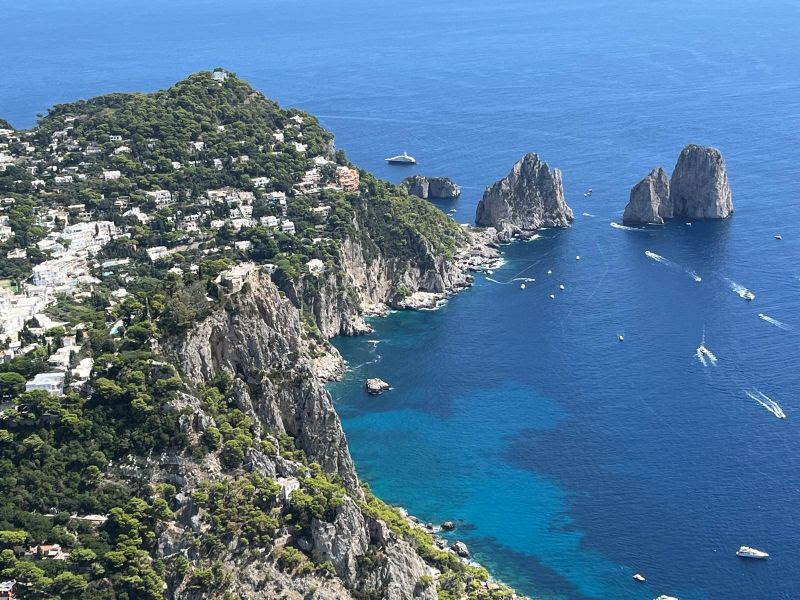
A historic milestone for the protection of the island’s natural heritage
After more than forty years of campaigning by Marevivo, the Isola di Capri Marine Protected Area has finally become a reality. The Chamber of Deputies has completed the parliamentary process establishing the new MPA following the final approval of the bill by the VIII Environment Committee of the Chamber of Deputies acting in a legislative capacity, marking a historic milestone in the protection of the island’s natural heritage.
Within six months of the law entering into force, the Ministry of the Environment and Energy Security will complete the procedures required to make the new protected area operational. The legislation also changes the designation of the proposed marine protected area previously known as “Penisola della Campanella – Isola di Capri”, formally separating the two areas into Punta Campanella and Isola di Capri, each with its own management framework.
The creation of the Capri Marine Protected Area fills a long-standing gap in Italy’s network of marine protected areas. Despite being one of the best-known and most visited islands in the Mediterranean, and home to natural heritage of international importance, Capri had until now lacked a dedicated protection framework. The new law finally addresses this anomaly and represents another important step towards the European Union’s 30×30 target, which aims to protect at least 30% of marine areas by 2030.
Marevivo has long called for Italy’s network of Marine Protected Areas to be expanded and strengthened. The country currently has 32 MPAs, including two submerged archaeological areas, compared with the 52 areas identified under Framework Law No. 394 of 1991, which consolidated the system of protected areas first established through Presidential Decree No. 979 of 1982 on the protection of the sea.
Over the years, the Foundation has consistently advocated for a more ambitious approach to marine conservation. In 2024, at the States General of Protected Areas organised by the Ministry of the Environment and Energy Security, Marevivo presented a proposal to reform the law governing Marine Protected Areas, bringing their legal framework into line with that of National Parks. The proposal called for marine heritage to be afforded the same status as terrestrial heritage, together with adequate funding, more effective governance and stronger monitoring and management tools.
However, the recent 23% reduction in funding allocated to National Parks, Nature Reserves and Marine Protected Areas is a serious cause for concern. Marevivo will continue to press for an appropriate solution to be included in the next Budget Law to ensure that sufficient resources are available to protect Italy’s natural heritage.
“Marevivo was founded more than forty years ago in Capri, where our first campaigns to protect the sea began. Since then, we have worked with dedication and determination to safeguard the island’s extraordinary biodiversity. We believe that Marine Protected Areas should not only be conservation tools, but also centres for scientific research, biodiversity monitoring, environmental education and the promotion of ocean literacy,” said Rosalba Giugni, President of Marevivo.
“For many years, we have run our ‘Guardian Dolphins’ programme in schools across Italy’s smaller islands because we believe that only by educating younger generations to respect the sea can we secure a future for our natural heritage.
“I would like to thank the municipalities of Capri and Anacapri, which, by installing mooring buoys to regulate boat access to the island’s most sensitive areas, including caves and the most heavily used bathing areas, have already introduced in practical terms one of the management tools that will form part of the future Marine Protected Area.
“My sincere thanks also go to all the members of Parliament who supported and promoted this important legislation, and in particular to Senator Lavinia Mennuni, who first introduced the bill, and Sergio Costa MP, Vice-President of the Chamber of Deputies, for their continued commitment throughout the process that led to the law’s approval. This result is the product of a collective effort and shows that when institutions, local authorities and civil society organisations work together towards a common goal, major achievements for the protection of our seas are possible.”
For Marevivo, the Capri Marine Protected Area represents far more than simply another area placed under protection. With its exceptional biodiversity, strategic position in the Mediterranean and global profile, Capri has the potential to become a model for development that brings together environmental conservation, scientific research, sustainable tourism and the blue economy.
Throughout its history, Marevivo has played a significant role in the creation of many of Italy’s Marine Protected Areas: from Ustica, the country’s first MPA, established in 1986, to the Tremiti Islands, Punta Campanella and the Egadi Islands; from the submerged archaeological parks of Baia and Gaiola to the international Pelagos Sanctuary for Marine Mammals and Capo Milazzo, the most recently established Marine Protected Area to which the Foundation also contributed.
This has been a journey built over decades through scientific research, public awareness campaigns and collaboration with institutions, local communities and citizens.
Remaining true to the mission with which it was founded in Capri more than forty years ago, Marevivo will continue to work alongside institutions, local communities and citizens to ensure that the new Marine Protected Area becomes an effective tool for biodiversity conservation, scientific research, environmental education and sustainable development, helping to establish Capri as a national and international benchmark for marine protection.